



It looks like something straight out of science fiction, but the Venus flytrap is very real, and it’s native to the Wilmington, North Carolina region, including its barrier islands. One of the world’s most iconic carnivorous plants, this remarkable species grows naturally in only a small stretch of the coastal Southeast, with Wilmington at the center of its range.
That makes this corner of the Carolina coast one of the only places on Earth where you can reliably see Venus flytraps in the wild, with no terrarium required.
This guide is for beginners, including curious travelers, nature lovers, families, and anyone who’s ever spotted a flytrap in a movie and thought, ‘Wait, those actually grow here?’ It covers the basics, including where to find them around Wilmington and how to explore responsibly, starting with the plant’s scientific name: Dionaea muscipula.
If you’ve ever wanted to see one in its natural habitat, Wilmington and its surrounding coastal preserves and beaches are where the hunt begins.
The first thing that surprises most visitors isn’t how dramatic the plant looks, but how easy it is to miss. Even in known habitats, you can be standing within a few feet of a cluster and not see it until your eye adjusts to the scale and color.
What Is a Venus Flytrap, Really?
Despite its fearsome reputation, a Venus flytrap is a low-growing, ground-level plant. Not the lunging, singing monster you might remember from Little Shop of Horrors.
What sets Venus flytraps apart from other plant carnivores is their highly specialized trapping mechanism.
Each trap is actually a modified leaf, connected by slender stems (petioles) and hinged like a tiny green bear trap, snapping shut in less than a second when triggered. Along the inside edges are tiny trigger hairs. When flying insects, or even grasshoppers, brush these hairs multiple times, the trap closes.
Up close, most traps are smaller than people expect, often no bigger than a quarter. The iconic snap is real, but in the wild, it’s something you’re more likely to imagine than actually witness unless you stop and watch for a while.
How They Eat
Once shut, the trap releases digestive enzymes that break down the insect. Over time, the trap reopens, ready to capture again. Old traps eventually die back as new traps grow, allowing the plant to continue feeding throughout the season.
Each individual trap typically functions only a few times before dying back, while new traps continue growing from the center of the plant throughout the season.
Why Wilmington?
The Venus flytrap has one of the smallest native ranges of any plant anywhere: a slim band of coastal plain around Wilmington in North Carolina, stretching just into neighboring South Carolina.
Here around Wilmington, flytraps thrive in open, sunny, fire-maintained environments, such as wetlands, bogs and longleaf savannas. These areas offer what the plant needs most, which is full sun, acidic conditions, and nutrient-poor soil.
If you’re walking through one of these areas and notice the landscape shift from dense growth to more open, sandy patches with low grasses and scattered pine needles, you’re getting closer to the kind of habitat where flytraps can survive.
After controlled burns or natural fires, locals often notice stronger flytrap growth, since these plants depend on open landscapes with minimal competition.
Take away that mix and the flytraps disappear, which is exactly why this stretch around Wilmington matters so much.
Is the Venus Flytrap Endangered?
Yes. That’s why responsible exploration matters.
The Venus flytrap faces ongoing threats from habitat loss, illegal poaching, and fire suppression, which allows woody plants to overtake the open landscapes flytraps depend on. Those pressures have pushed wild populations into serious decline, and conservation groups now treat the Venus flytrap as an endangered species, even as federal protections are still being debated.
Protections and conservation oversight are provided by the U.S. Fish and Wildlife Service, and USDA guidelines regulate the transport and sale of flytraps.
In North Carolina, digging up Venus flytraps from the wild is a felony. Many first-time visitors don’t realize this until they arrive.
Where to View Venus Flytraps
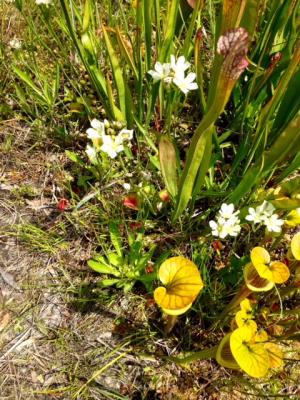
> Stanley Rehder Carnivorous Garden:
If you want an easy first encounter, start at the Stanley Rehder Carnivorous Plant Garden, where the flytraps cluster so thickly it can feel like the ground is dotted with small, open traps in every direction.
This public garden in Wilmington, protected by a conservation easement held by the Coastal Land Trust, showcases the region’s native carnivorous plants in a protected setting designed to reflect natural bogs and wetlands.
The garden is open year-round, though the best time to visit is May through June.
During peak bloom, delicate white flowers rise above the traps, an adaptation that keeps pollinators safely out of reach of the plant’s feeding mechanism. The contrast is subtle but striking once you notice it.
> Carolina Beach State Park: 
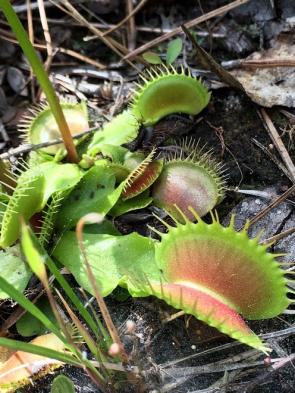
The park features a dedicated Flytrap Trail and a carnivorous bog garden behind the visitor center.
The park also offers seasonal ranger-led programs focused on carnivorous plants, which can be one of the most reliable ways for first-time visitors to spot Venus flytraps and learn how to identify them in the wild.
The easy loop trail winds through longleaf pine forests and grassy savannas.
Keep an eye on the wetter, scrubby edges of the trail.
A helpful approach is to slow your pace and scan in small sections rather than walking continuously. Once you spot one plant, you’ll usually start seeing more nearby. Flytraps rarely appear completely isolated.
> Airlie Gardens:
Known for its azaleas and live oaks, Airlie Gardens also includes a carnivorous plant section. The Waterwise Garden features a bog area designed to showcase native species in a controlled, easy-to-view environment.
This is often the easiest place for first-time visitors to clearly see the structure of a Venus flytrap before trying to spot them in the wild.
Where to Shop for Carnivorous Plants
Because the Venus flytrap is native only to a roughly 75-mile radius around Wilmington and its beaches, you’re in the best possible place to find them.
However, since they’re protected, you must buy from reputable nurseries and growers rather than collecting from the wild.
Local growers often emphasize that plants sourced from within the region tend to be more resilient, since they’re already adapted to the coastal climate. Availability can be seasonal, especially in late spring.
Where to buy a Venus flytrap plant locally:
-
The Plant Place (6112 Market St, Wilmington)
A frequently recommended garden center carrying a wide range of houseplants and seasonal specialty items, including Venus flytraps.
-
New Roots Nursery (442 Semmes Drive, Wilmington)
A specialized backyard nursery that lists Venus flytraps, pitcher plants, and sundew. Typically open by appointment or seasonal sales.
-
The Plant Outpost (624 S 17th St Unit B, Wilmington)
A trendy plant shop in the Cargo District known for uncommon species; locals have reported recent flytrap availability.
Also known as Joel’s Carnivorous Plants, this Wilmington-based operation sells online only. No walk-ins, but plants are grown right in their native climate.
Plan Your Flytrap-Focused Wilmington Visit
Pair a morning of flytrap-spotting with fish tacos on the riverfront or a lazy afternoon swim at Carolina or Wrightsville Beach. From the laid-back shores to the riverfront views downtown, it’s easy to turn a plant-spotting adventure into a full vacation.
Timing your visit adds another layer of magic:
-
Late spring for blooming season
- Summer for mature traps and beach weather
Early morning is often the best time to look. The light is softer, and subtle color differences are easier to spot before the midday sun flattens the landscape visually.
After rain, the surrounding vegetation can settle slightly, making the low-growing traps stand out more clearly against the ground.
There are only a few places on Earth where you can see a Venus flytrap in the wild.
Even fewer where you can do it in the morning and watch the sunset over the Atlantic that same day.
Wilmington’s coast is one of them.