



Moored along the Cape Fear River near Historic Downtown Wilmington, the Battleship NORTH CAROLINA – also known as “The Showboat” – has been part of the city’s waterfront for more than 60 years. Yet the Battleship’s story began long before she arrived in North Carolina. Commissioned in 1941, she became one of the most accomplished American battleships of World War II, serving in every major naval offensive across the Pacific and earning 15 battle stars along the way.
After the war, the Battleship was slated for scrapping until North Carolinians launched a statewide “Save Our Ship” campaign to preserve her. In 1961, she made her journey up the Cape Fear River to Wilmington, where she still stands today as a World War II memorial and one of the city’s most visited historic attractions.
In this Q&A, Mary Ames Booker, the award-winning curator of collections and interpretation for the Battleship, shares how she brings the ship’s history to life, the stories and surprises visitors might discover onboard, and a few of her favorite ways to explore Wilmington’s history beyond the Battleship.
What are some aspects of your professional journey leading up to your time at the Battleship NORTH CAROLINA?
My interest in working in the history profession began in college when I was an intern for the Library of Congress and the National Museum of American History. My college and graduate degrees are in history. Before coming here nearly 24 years ago, I worked as a curator for the Billings Farm & Museum in Vermont, the Southern Oregon Historical Society and for a private exhibit design firm.
What drew you to Wilmington and inspired you to take on this role at the Battleship?
I was intrigued by the opportunity to interpret World War II history to the public in a unique setting. My father served during the war, so I also have a personal connection.
What makes curating a battleship different from working with more traditional historic sites, such as a historic home?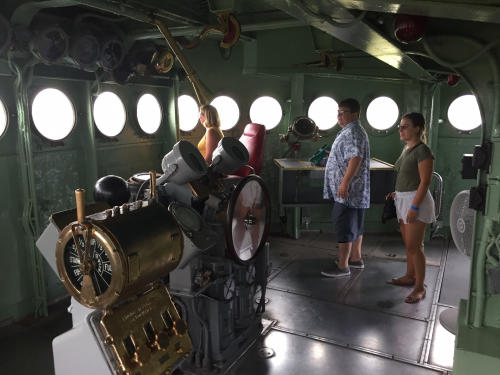
There is far more to the Battleship NORTH CAROLINA than visitors may realize. It was a “city at sea” for 2,300 men with living and dining spaces, as well as a hospital, post office, barber shop, stores, soda fountain, print shop, laundry, tailor shop, library and much more. She had to carry an enormous quantity of supplies. The ship needed many repair shops to fix equipment at sea, and she was a fueling station for destroyers while underway!
On the technical side there were computers, radar equipment, multiple radio rooms, four engine rooms, two navigational compasses and even machinery to turn the salty ocean into fresh water. She had her primary mission during the war, but a ship this size is far more complex than many may realize.
You’ve said you have a foundational belief that “curator means keeper.” How does that philosophy shape your day‑to‑day work aboard the Battleship?
I work with amazing colleagues and volunteers who care deeply about the integrity of the Battleship as the state’s World War II memorial and her role to defend freedom against tyranny. We all strive to honor her history every day.
When you reflect on your time here so far, what accomplishments or projects are you most proud of?
The Battleship has a self-guided route with interpretive signs explaining each compartment you see, including quotes from the men who worked or lived there. It’s all written to be accessible to all, from families to non-military visitors and history enthusiasts alike. It has been decades of work by a handful of dedicated staff and volunteers. And during my time here, we’ve added new areas to the tour route and brought many spaces to “life” with furnishings based on solid, historical research. We are also testing audio presentations as visitors walk through spaces.
 Battleship NORTH CAROLINA arriving in Wilmington
Do you have a favorite story or “fun fact” from the Battleship’s history?
I have several! The Battleship NORTH CAROLINA could carry almost 2 million gallons of fuel oil and averaged 165 gallons per mile. She moved 32 feet per gallon. The ship produced 8.4 megawatts of electricity, enough to power a small town of 6,500 people. She had nine captains, all graduates of the U.S. Naval Academy. All but one were promoted to admiral upon leaving the ship, and he was promoted later.
Do you have any “insider tips” for exploring the Battleship?
The Battleship NORTH CAROLINA is large and visitors can easily spend two hours exploring her. It’s well worth it! She is authentically restored and has more open spaces than many other historic ships. Just follow the arrows and you won’t get lost as you weave through the ship. Personal guided tours are also available in the morning, and a “Hidden Battleship” program is offered four times a year. Details are on our website: www.battleshipnc.com.
Part of your role is overseeing artifact donations and collections. What are a few artifacts on display that you find especially meaningful or interesting?
The artifacts related to the battle of Iwo Jima in February 1945 are quite special. There is a rubber intelligence map that was used on the ship to study the island along with a secret map used to direct and monitor gunfire. Visitors can see a container of the “Sands of Iwo Jima,” which is volcanic rock, and imagine what our Marines confronted in their assault. Then onboard the ship visitors see and learn about the state-of-the-art 1930s computers and the classified Electric Ciphering Machine for sending and receiving messages in code.
What places in Wilmington and our island beaches do you recommend visitors explore before or after touring the Battleship?
I encourage visitors to explore our local history by visiting the Cape Fear Museum of History and Science (set to reopen in its new location on Grace Street this summer), Bellamy Mansion Museum of History & Design Arts, Latimer House Museum, Wilmington Railroad Museum and Fort Fisher State Historic Site, among others. Their staff and volunteers love sharing their stories!
To learn more about Wilmington’s historic sites and experiences, check out this link.